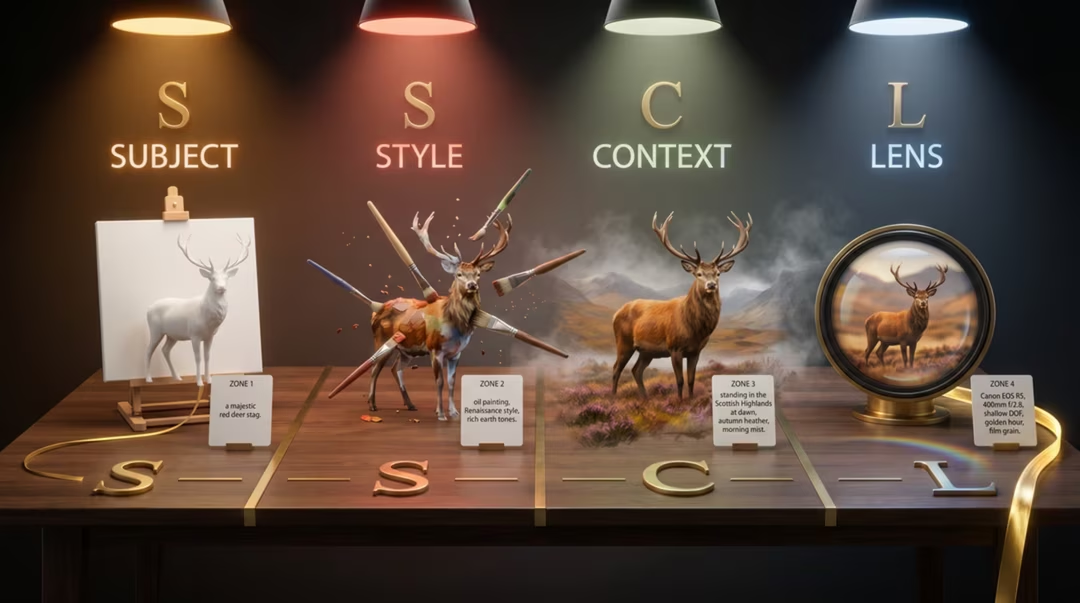
Most weak prompts are not badly written. They are incomplete. They name a subject and stop, leaving the model to invent the setting, the framing and the light — the three things that decide whether an image looks intentional.
SSCL exists to prevent that. It is a checklist you can run in ten seconds, and it works whether you are typing into Midjourney, Gemini or a chat window.
Key takeaways
- Subject: who or what, described concretely rather than categorically.
- Scene: where and when, including weather and time of day.
- Composition: framing, distance, angle and lens.
- Light: direction, quality, colour and contrast.
- Add medium, mood, palette and constraints only after those four are working.
Why a formula helps
A model fills every gap you leave. If you do not specify light, you get generic light. If you do not specify framing, you get a centred mid-shot, because that is the average of everything it has seen.
SSCL is not a magic incantation. It is simply the minimum information required to describe a photograph or an illustration to someone who cannot see what is in your head.
S — Subject
Be concrete. "A woman" is a category; "a woman in her fifties in a paint-flecked apron" is a person. Specific detail narrows the space of possible images dramatically.
Include one telling detail rather than five generic ones. A single scar, a worn cuff, a particular tool in hand does more than a paragraph of adjectives.
S — Scene
Where and when. Interior or exterior, the type of place, the season, the time of day, the weather. Each of these constrains everything else in useful ways.
Time of day is the highest-value word in this block, because it implies light, colour temperature and often mood without you stating them.
C — Composition
Say how the frame is arranged: close-up, waist-up, wide shot; eye level, low angle, overhead; centred or on a third. Add a focal length, because lens language carries perspective information compactly.
If the image needs empty space for a headline, say so here. It is far more reliable than cropping later.
L — Light
Direction, quality, colour, contrast. "Soft overcast light from a large window on the left, no direct sun, gentle shadows" is a complete lighting brief in one clause.
Beginners skip this block most often, and it is the one that separates a snapshot from a photograph. If you only improve one thing about your prompts, improve the light.
Subject: a violin maker fitting a soundpost, half-moon glasses, sawdust on her sleeves Scene: a cluttered workshop in Cremona, mid-morning in winter Composition: close three-quarter view, hands and instrument prominent, 50mm, subject slightly left of centre Light: cool north window light from the left, warm bench lamp filling the shadows
Labels are for you, not the model. Remove them before generating.
The same brief in five tools
The information stays constant; the phrasing adapts. This is the single most useful exercise for understanding your tools.
violin maker fitting a soundpost in a Cremona workshop, winter morning, close three-quarter view, cool window light with warm lamp fill, 50mm, quiet craftsmanship, muted palette
Compressed and evocative. Midjourney fills in beauty on its own.
A photograph of a woman in her sixties fitting a soundpost inside a violin, wearing half-moon glasses and a canvas apron with sawdust on the sleeves. A cluttered Cremona workshop in winter. Close three-quarter view with hands and instrument prominent, 50mm lens at f/2.8, subject left of centre. Cool north window light from camera left with a warm incandescent bench lamp filling the shadows. Natural colour, fine grain, no retouching.
Literal, complete sentences. FLUX rewards specificity and punishes vagueness.
Workshop scene, single subject. Violin maker, sixties, half-moon glasses, canvas apron. Setting: cluttered Cremona workshop, winter morning. View: close three-quarter, hands prominent. Lighting: cool window light from left, warm lamp fill. Style: realistic photographic concept, consistent with a documentary series.
Orderly and labelled. Leonardo responds well to briefs that read like specifications.
Please create a documentary-style photograph of a violin maker in her sixties fitting a soundpost, in a cluttered Cremona workshop on a winter morning. Close three-quarter view, hands prominent, 50mm. Cool window light from the left with a warm bench lamp filling the shadows. Keep it unposed and natural, and include no text in the image.
Conversational tools accept ordinary sentences, then let you refine in the next message.
| Block | Midjourney | FLUX.2 | Conversational tools |
|---|---|---|---|
| Subject | Short noun phrase | Full description with detail | Natural sentence |
| Scene | Place plus time | Place, time, condition | Place plus time |
| Composition | Shot type plus lens | Shot, lens, aperture, position | Shot type plus what to leave empty |
| Light | Two or three words | Direction, source, fill, quality | One clear sentence |
What to add after SSCL
Medium comes first: photograph, gouache, screen print, 3D render. Then mood, then palette, then constraints such as "no text" or "single subject".
Add these one at a time. If you add four at once and the image gets worse, you have no idea which one caused it.
A ten-second habit
Before generating, read your prompt and ask: subject, scene, composition, light — is each present? If one is missing, that is almost certainly what the model will get wrong.
Frequently asked questions
What does SSCL stand for?
Subject, Scene, Composition, Light. Those four blocks answer the questions image models most need answered before you add medium, mood or constraints.
Does the order of the blocks matter?
Somewhat. Many models weight earlier terms more heavily, so leading with the subject is usually sensible. The bigger benefit is that the order stops you forgetting a block.
Can I use SSCL in conversational tools?
Yes. Write the four blocks as a natural sentence rather than as a list. The structure still ensures nothing important is missing.
What comes after SSCL?
Medium, mood, palette and constraints. Add them once the four core blocks are producing a usable image, one at a time so you can see each effect.
Why is light its own block?
Because light does more to determine the feel of an image than any style keyword, and because it is the block beginners most often omit entirely.
Return to the pillar guide for the complete method: iteration, model-specific phrasing, negative prompting and realism techniques.
Continue the series
The other chapters in the AI Prompt Engineering guide.