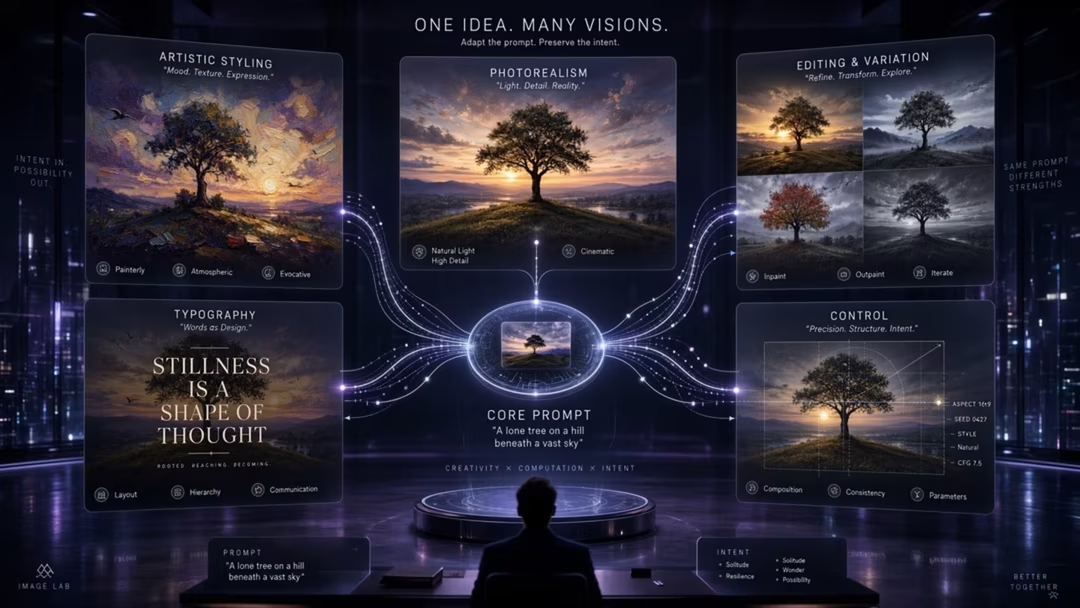
A prompt is written for a model, not for the industry. Each system has a different text encoder, a different training history and different built-in tendencies, so the same words land differently.
The fix is not more words. It is the right register: compressed and evocative for some tools, literal and technical for others, conversational for the rest.
Key takeaways
- Keep the information constant; change the phrasing per model.
- Midjourney rewards mood and medium; FLUX rewards camera and material precision.
- Leonardo prefers orderly, specification-like briefs.
- GPT Image 2 and Nano Banana 2 want plain sentences plus follow-up corrections.
- Ideogram wants quoted text and layout language.
Why one prompt does not fit every model
Models differ in how much they infer. Some fill gaps generously with their own aesthetic; others take you at your word and leave unstated things unstated.
That single difference explains most cross-tool disappointment. A prompt that works in a generous model looks thin in a literal one, and a prompt written for a literal model can feel over-specified elsewhere.
Our reference scene throughout: a bookbinder at work in a small workshop, late afternoon.
Midjourney: aesthetic language
Midjourney has strong opinions and applies them. Give it mood, medium and a few strong nouns, and let it handle beauty. Long literal descriptions tend to dilute rather than sharpen.
bookbinder stitching a text block in a small workshop, late afternoon light, leather and linen thread, 50mm, quiet craft, muted warm palette, documentary photograph
Around twenty words. Everything present is visual; nothing is a compliment.
Leonardo: structured scene building
Leonardo responds well to briefs that read like specifications: subject, setting, view, lighting, style. That order also makes prompts easy to reuse across a set.
Subject: bookbinder, fifties, apron, stitching a text block. Setting: small workshop with presses and paper stacks. View: three-quarter, hands prominent, medium shot. Lighting: warm late-afternoon window light from the right, soft fill. Style: realistic photographic, consistent with a documentary series.
Labelled clauses keep a whole series consistent when you reuse the block.
FLUX: literal visual specificity
FLUX.2 rewards being taken literally. State the lens, the aperture, the light sources, the materials and their behaviour. Vagueness produces vague results because nothing is being invented for you.
A photograph of a bookbinder in her fifties stitching a text block on a wooden bench. Small workshop with cast-iron presses and stacked paper. Medium shot, three-quarter view, hands prominent, 50mm lens at f/2.8, ISO 400. Warm late-afternoon sunlight through a window at camera right, soft bounce fill from a white wall at left. Visible linen thread texture, worn leather, fine dust in the air, natural colour, mild grain, no retouching.
Roughly seventy words, almost all physical description. This is the register FLUX likes.
GPT Image 2 and Nano Banana 2
Conversational tools want a brief, not a keyword string. Lead with the purpose, include constraints, and then correct in the next message rather than rewriting.
Please create a documentary photograph of a bookbinder stitching a text block in a small workshop, late afternoon. Medium shot with her hands prominent. Warm window light from the right. Keep it unposed, include no text in the image, and leave the left side relatively uncluttered.
Then: "Lower the camera slightly and keep everything else exactly the same."
A realistic photo of a bookbinder sewing pages in a small workshop in the late afternoon, warm light from a window on the right, natural and unposed, close enough to see her hands clearly.
Plain sentence first, then refine in the conversation. Over-specifying here adds little.
Ideogram: text-in-image prompting
When words must appear, quote them exactly and describe their position. Keep copy short: two strings is comfortable, a paragraph is not.
A workshop sign hanging above a bookbinder's bench. The words "Bindery" in a bold serif on the sign, and "Est. 1974" in small letters beneath. Warm interior light, shallow depth of field behind the sign, no other text anywhere in the image.
Quote, place, then forbid extra text. That third clause prevents invented signage.
Side-by-side comparison
| Model | Ideal length | Register | Rewards | Avoid |
|---|---|---|---|---|
| Midjourney | 15–30 words | Compressed, evocative | Mood, medium, palette | Long literal lists |
| Leonardo AI | 35–60 words | Specification-like | Orderly clauses, asset briefs | Poetic vagueness |
| FLUX.2 | 50–90 words | Literal, technical | Lens, light, material behaviour | Abstract style words |
| GPT Image 2 | 30–60 words | Conversational brief | Constraints and revisions | Keyword soup |
| Nano Banana 2 | 20–40 words | Everyday sentence | Plain description, edits | Parameter syntax |
| Ideogram 3 | 25–50 words | Layout-led | Quoted copy, placement | Long paragraphs of text |
A useful exercise
Take one prompt you already like and rewrite it in all six registers. Half an hour of that teaches more about your tools than a month of reading, including this page.
Frequently asked questions
Why does my Midjourney prompt fail in FLUX?
Midjourney prompts are usually compressed and evocative, and rely on the model's built-in aesthetic. FLUX expects literal description and technical detail, so the same short prompt gives it too little to work with.
Is there a universal prompt format?
The content is universal: subject, scene, composition and light. The phrasing is not. Keep the information constant and change the register for each tool.
Which model is easiest for beginners?
Conversational tools such as Nano Banana 2 and GPT Image 2 are the gentlest starting points because ordinary sentences work and corrections happen in dialogue.
How should I prompt for text in an image?
Quote the exact words, keep them short, and describe where they sit. Ideogram 3 is the leading option for this, and GPT Image 2 handles short strings well.
Do these differences change over time?
Yes. Models are updated regularly and their sensitivities shift. Re-test your standard prompts after any major version change rather than assuming they still behave the same way.
Return to the pillar guide for the complete method: iteration, model-specific phrasing, negative prompting and realism techniques.
Continue the series
The other chapters in the AI Prompt Engineering guide.