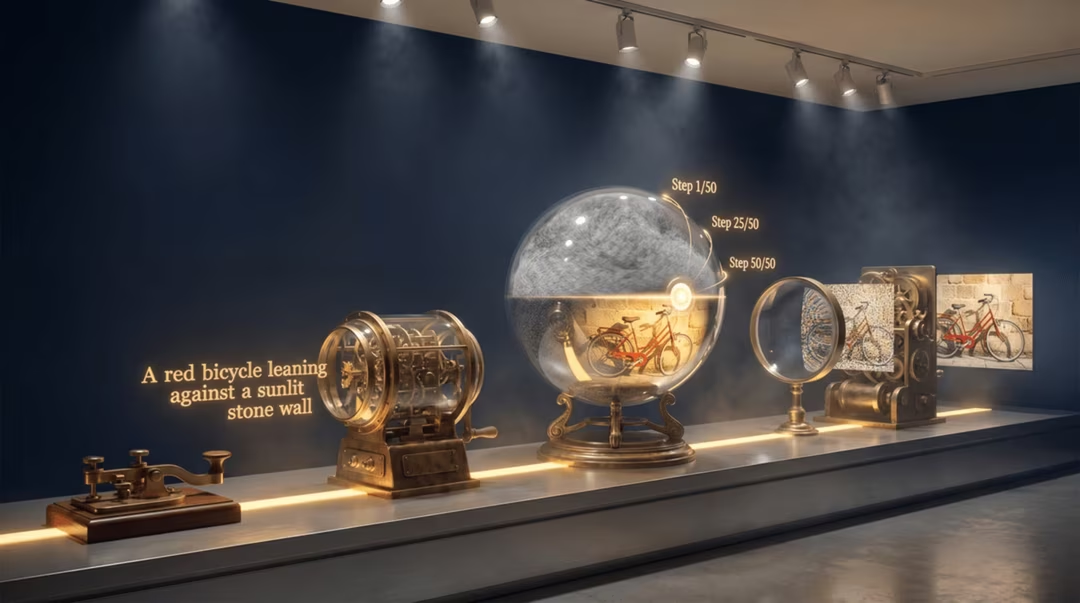
You do not need this knowledge to make good images, in the same way you do not need to understand sensors to take a good photograph. But a rough mental model explains most of the odd behaviour you will encounter, and it stops you from believing nonsense.
We will build the picture in order: training, text understanding, diffusion, latent space, guidance, sampling, then the practical operations of image-to-image, inpainting and upscaling. Finally, provenance and the ethical limits.
Key takeaways
- Models generate new pixel data. They do not retrieve or collage existing images.
- Diffusion works by learning to reverse noise, one small step at a time.
- Latent space is a compressed version of an image, which is why generation is fast enough to use.
- Guidance controls obedience to your text; sampling steps control how many refinement passes happen.
- C2PA and content credentials record provenance, but support is uneven and metadata can be stripped.
Text-to-image, in one paragraph
You write a description. A language component converts it into numbers that represent meaning. An image component starts from random noise and repeatedly adjusts it so that it looks more like something matching that meaning. After enough steps, the noise has become a picture.
That is genuinely the whole shape of it. Everything else is detail about how each part is implemented.
Training, at a high level
Models learn from very large collections of images with associated text. Through that exposure they build statistical associations: what "harbour at dawn" tends to look like, how metal reflects light, how a face is arranged.
Importantly, the finished model does not contain those images. It contains learned parameters. This is why a model can produce something that has never existed, and also why it inherits the biases and gaps of what it was shown.
Questions about consent, licensing and compensation for training data are real and unresolved in many jurisdictions. They are separate from the mechanics, and we do not pretend they are settled.
Diffusion: sculpting from noise
During training, the model is repeatedly shown images with noise added, and learns to predict what the noise was. Do that well enough and you can run the process backwards: start from pure noise and remove it step by step.
The useful analogy is a sculptor with a block of marble, except the marble is static and each pass removes a little of what does not belong. Your prompt is the brief telling the sculptor what should remain.
This explains why generation is probabilistic. Different starting noise leads to a different final image even with an identical prompt, which is exactly what the seed controls.
Why vague prompts fail
At each step the model asks "does this look more like the description?" A vague description makes almost anything acceptable, so it settles on the most average answer available.
Latent space and transformers
Doing all this at full resolution would be impossibly slow. Instead most systems work in latent space: a compact numerical representation that preserves structure while discarding redundancy.
Think of it as working from a detailed plan rather than laying every brick. Once the plan is finished, a decoder converts the latent representation into the visible image.
Transformers handle relationships between parts of an input. On the text side they interpret your sentence; in newer architectures they also help the image side keep distant regions of a picture consistent with each other.
Tokens, guidance and sampling
Your prompt is split into tokens. Words with strong visual associations carry weight; connective words carry little. Terms placed early often influence the result more than terms buried at the end.
Guidance, often labelled CFG, sets how strictly the image must match your text. Turn it up and the model obeys, sometimes at the cost of natural-looking results. Turn it down and it improvises.
Sampling steps determine how many refinement passes happen. More steps are not automatically better; beyond a point you are spending time for imperceptible change.
| Control | Effect | Practical advice |
|---|---|---|
| Seed | Sets the starting noise | Fix it when comparing prompt changes |
| Guidance / CFG | Strictness of text adherence | Mid-range for realism; high can look forced |
| Steps | Number of refinement passes | Diminishing returns past a moderate value |
| Strength (image-to-image) | How much of the source survives | Low for subtle edits, high for reinvention |
| Aspect ratio | Frame shape | Set before generating, not by cropping later |
Image-to-image, inpainting, upscaling
Image-to-image starts the process from an existing picture rather than from pure noise. A strength setting decides how much of the original survives, which makes it ideal for controlled variation.
Inpainting regenerates a selected region while leaving the rest untouched — the tool for removing an object or fixing a hand. Outpainting extends the canvas beyond its original edges.
Upscaling increases resolution and, in most modern implementations, invents plausible detail as it does so. That is fine for texture and risky for text or fine structure, so check the result at full size.
Regenerate only the selected area: replace the parked car with empty road surface matching the existing asphalt texture, shadow direction and colour. Leave everything outside the selection untouched.
Describe what should be there, not what should be removed. Models fill; they do not erase.
Use this image as the starting point at low strength. Keep the composition and subject. Change the season to late autumn: bare branches, fallen leaves, cooler light. Preserve the camera angle exactly.
Low strength preserves structure; high strength effectively starts again with a hint.
Reasoning image models
Some newer systems add an interpretive stage before rendering. Rather than going straight from text to noise-removal, they first work out what the brief requires: which objects, how arranged, what text must appear.
This tends to improve instruction-following, particularly for counts, spatial relationships and short text. It usually costs time. Neither behaviour is a claim about comprehension; it is a description of what these systems do.
Provenance and ethics
C2PA is an open standard for attaching provenance information to a file. Content Credentials is the implementation most creators meet, and it can record that an image was generated or edited with AI.
Support varies by tool and platform, and metadata is often stripped when images are uploaded, re-encoded or screenshotted. Treat credentials as a helpful signal rather than proof.
The ethical points are simpler than the technology. Do not present generated images as documentary evidence. Do not depict real people in fabricated situations. Disclose AI involvement where it would matter to a reasonable viewer.
An obviously illustrated conceptual image, not photographic: a flat-colour illustration of a person balancing books, limited three-colour palette, visible paper texture, no attempt at realism
When a subject is sensitive, choosing a clearly illustrative style is itself a form of disclosure.
Frequently asked questions
Does an AI image generator copy existing images?
It does not retrieve or paste existing files. It generates new pixel data guided by patterns learned during training. Debates about training data and copyright are real and ongoing, but they are separate from how generation itself operates.
What is latent space?
A compressed numerical representation of images. Working in this compact space rather than in full-resolution pixels is what makes generation fast enough to be practical. A decoder converts the finished latent into a viewable picture.
What does CFG or guidance do?
It controls how strictly the model follows your text. Low values wander and can look more natural; high values follow instructions closely and can look stiff or over-saturated. Mid-range settings suit most work.
What is the difference between inpainting and outpainting?
Inpainting regenerates a selected region inside an existing image. Outpainting extends the image beyond its original borders. Both keep the rest of the picture intact.
How does a seed affect the result?
The seed determines the starting noise pattern. Reusing the same seed with the same prompt and settings reproduces a very similar image, which makes it useful for controlled comparisons.
Return to the pillar guide for the full picture: how these systems work, how the model landscape fits together, and which tool suits which job.
Continue the series
The other chapters in the AI Image Generation guide.