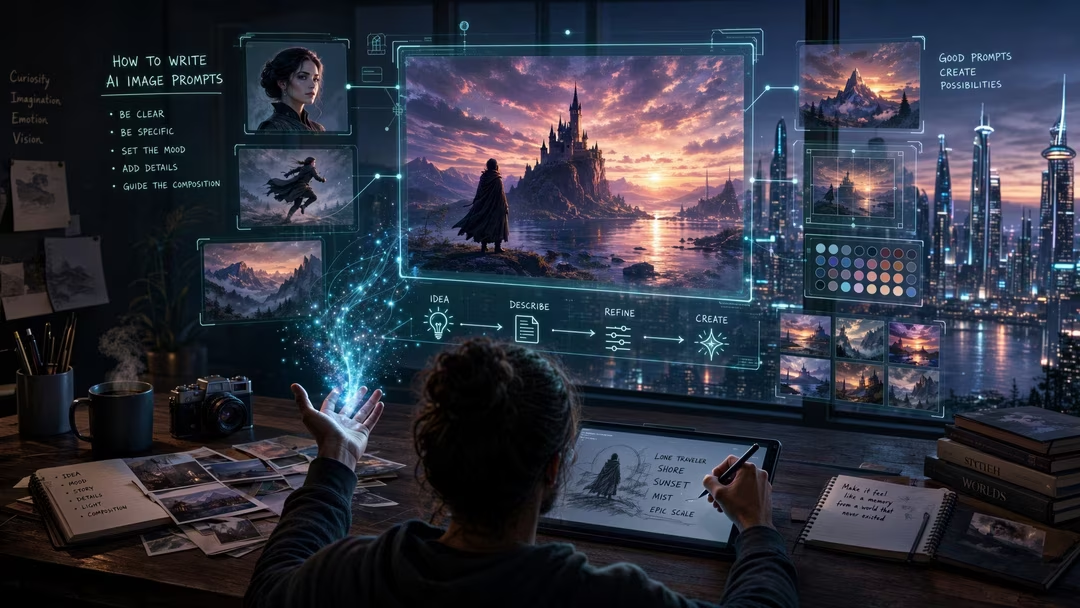
Key takeaways
- Every strong prompt answers five questions: what, where, how it’s lit, how it’s shot, and how it feels.
- Specific nouns and verbs beat stacked adjectives — “rim light on the shoulder” outperforms “beautiful dramatic lighting.”
- One lighting decision, one palette anchor pair, one framing cue: discipline compounds.
- The fastest learning loop is reading generated breakdowns against images you already love.
Prompt anatomy in five slots
Almost every effective image prompt fills the same five slots, in roughly this order: subject (who or what), environment (where), light (direction, quality, temperature), camera (distance, lens feel, depth of field), and style + mood (the aesthetic wrapper and emotional register). You don’t need all five every time, but when an image feels “off,” one of the five is usually empty or fighting another.
The deep dive on each slot — with the exact section labels the VISIORA tools use — lives in Anatomy of a Great AI Image Prompt.
Vocabulary that moves models
Light
Name direction and shadow behavior together: “soft key from camera left with gentle falloff,” “hard noon light with short black shadows,” “backlight turning edges to gold.” Temperature pairs anchor the grade: “cool shadows, warm skin.”
Lens
Focal length is shorthand for compression and distance. “35mm environmental” invites context; “85mm at f/1.8” isolates; “24mm from the floor” adds energy. Add depth-of-field language (“razor-thin focus,” “deep focus throughout”) to be explicit.
Color
Two or three named anchors beat “colorful.” “Burnt amber, deep teal, near-black” is a grade; “vibrant colors” is a coin flip.
Mood
Mood words steer expression and detail density: “quiet,” “tense,” “wry,” “reverent.” One is enough; three cancel out.
Examples, weak to strong
A beautiful cinematic portrait of a woman, amazing lighting, highly detailed, 8k.
Every phrase is a judgment, not an instruction. The model must invent the actual decisions.
Editorial portrait of a woman in her sixties with silver hair, seated by a north-facing window, soft directional light from camera left, gentle falloff into shadow on the far cheek, 85mm at f/2, muted ivory-and-slate palette, natural skin texture, dignified calm mood.
Same subject, but now every slot is filled with a decision the model can execute.
Common mistakes
- Adjective stacking — “stunning, epic, ultra-realistic” adds noise and often triggers the glossy default look.
- Contradictions — “bright airy” plus “moody dramatic” forces a compromise that satisfies neither.
- Missing light — the single most common empty slot, and the biggest driver of mood.
- Resolution talk — “4k, 8k” doesn’t add detail; texture and material words do.
- Editing five things at once — when the next render changes, you learn nothing. See one-variable iteration.
Using the generator to learn
The fastest shortcut isn’t a cheat sheet — it’s a feedback loop. Upload images you admire to the AI Prompt Generator, read how each visual decision gets described, and steal the phrasing that matches what you see. Do that ten times and your own prompts permanently level up. Then browse the Prompt Library to see the same discipline applied across styles, each with a full breakdown.
Practice loop
Write a prompt from imagination → generate → upload the result back to the generator → compare its description to yours. The gap between the two is exactly what you need to learn.
FAQ
How long should a prompt be?
As long as its decisions. Forty precise words beat two hundred vague ones. If a phrase doesn’t change the image, cut it.
Does word order matter?
Slightly — earlier phrases tend to get more weight in most models. Put the subject and light first.
Should I write sentences or comma lists?
Either works; consistency matters more. Natural sentences suit ChatGPT-family models; lists suit Stable Diffusion workflows.